Step into a newly renovated penthouse or a carefully restored historic brownstone today, and look up. For the past decade, your gaze would likely have met a swiss-cheese ceiling—an endless, sterile grid of recessed can lights punching dark holes into white plaster. Today, that grid is gone. In its place rests a quiet revolution of low-profile ceiling fixtures, sculptural brass disks, and textured linen flush mounts that hug the drywall like structural jewelry. We are witnessing a profound collective exhaustion with the "invisible" light of the 2010s, a design era defined by the pursuit of illumination without presence.
The shift is startlingly physical. Designers are no longer treating lighting as the final afterthought ticked off a contractor’s punch list. Instead, lighting has become the foundational vocabulary of spatial design. Walk through any high-end residential project this year, and you will find that fixtures are selected before the paint swatches are taped to the wall or the hardwood flooring is laid. This reversal of priorities stems from an urgent demand: spaces must feel intimate, grounded, and texturally rich, yet ceilings in modern construction are stubbornly dropping lower. We want the drama of a chandelier without the low-hanging hazard, and the clean distribution of downlights without the clinical glare of an operating room.
For years, the American real estate market worshipped the recessed luminaire. It promised clean sightlines, uninterrupted planes, and the illusion of height. Yet, those hollow cylinders of aluminum and glass created an oppressive, downward-directed spotlight effect that flattened rooms and cast harsh shadows under human eyes. As architectural ceiling heights compress in urban multi-family developments, and as homeowners spend more waking hours working, relaxing, and gathering in multi-functional living spaces, the limitations of the "spotlit box" have become glaringly obvious. Low-profile fixtures have stepped into this vacuum, not merely as a compromise for low ceilings, but as a sophisticated design statement that redefines how light interacts with volume, shadow, and human well-being.
The Architectural Death of the Sterile Recessed Grid and the Rise of Surface-Mounted Craft
The architectural consensus has fundamentally pivoted. For over twenty years, builders treated recessed cans as default options, installing dozens of them across every square foot of ceiling space under the banner of "bright, even lighting." This approach ignored a fundamental biological reality: humans do not thrive under a vertical rain of high-intensity lumen output. Instead, our visual systems crave ambient bounce, soft lateral diffusion, and focal points that draw the eye horizontally rather than pulling it straight down to the floor. Recessed lights also breach the thermal and acoustic envelope of a ceiling, creating pathways for air leakage and sound transmission between floors—a hidden structural penalty that modern sustainable design increasingly rejects.
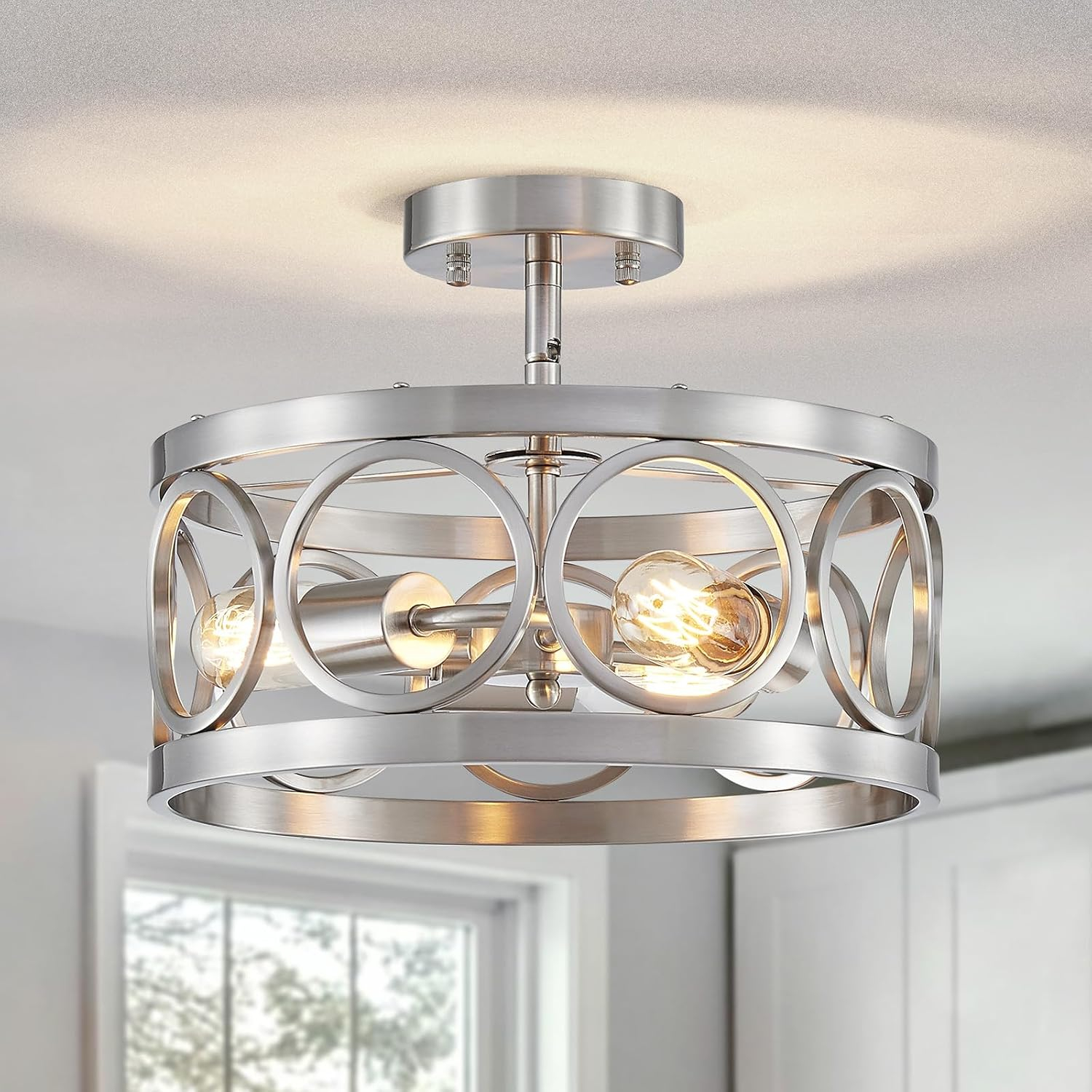
Enter the low-profile flush mount and shallow semi-flush fixture. These modern iterations bear little resemblance to the dated, buggy-whip dome lights of mid-century tract homes. Today’s low-profile designs utilize edge-lit LED technology, high-output integrated diodes, and wide-angle optical lenses to disperse light outward across the ceiling plane before it washes down into the room. By utilizing the ceiling as a primary reflector, these fixtures generate a soft, volumetric glow that eliminates stark contrast ratios. The room feels larger because the boundaries—the ceiling corners and wall junctures—are gently kissed by ambient spill, rather than plunged into cave-like darkness while a hot spot burns a hole in the center of the Persian rug.
Beyond illumination metrics, the material narrative has transformed. Artisans and high-end manufacturers are utilizing hand-blown opaline glass, textured ceramic glazes, woven abaca, perforated blackened steel, and warm brushed brass. A low-profile fixture acts as a low-slung crown jewel on the ceiling plane. It breaks up the monotony of vast plaster expanses without demanding the vertical clearance of a chandelier. In spaces where 8-to-9-foot ceilings are the frustrating urban norm, a 2-inch-thick sculptural disc provides the visual weight and artistic focal point of a statement pendant while maintaining code-compliant clearance for tall guests to walk underneath without ducking.
Human-Centric Metrics: Quantifying the Shift to Layered, Low-Glare Environments
Evaluating lighting performance requires looking past simple wattage and lumen counts into the physiological impacts of modern optics. The human eye is exceptionally sensitive to direct glare, which occurs when a light source’s luminance vastly exceeds its immediate surroundings. Recessed downlights, by their very nature, concentrate high-intensity lumens into a narrow beam angle, creating high-contrast hot spots on horizontal surfaces and blinding glare if an occupant looks directly upward. Low-profile surface fixtures distribute the same—or greater—lumen package across a broad physical surface area, drastically lowering the surface brightness (measured in candelas per square meter) while maintaining high overall room efficacy.
Furthermore, the technological integration of tunable white LEDs has converged with low-profile hardware to support human circadian rhythms. In 2026, residential lighting specifications routinely demand a Correlated Color Temperature (CCT) range spanning from a cozy, melatonin-friendly 2200K in the evening hours to an alert, productive 4000K during mid-day tasks. Because low-profile fixtures sit flush or nearly flush against the ceiling junction box, they conceal sophisticated driver housings and wireless mesh radio modules (such as Matter, Zigbee, or Thread) without requiring bulky remote transformers hidden in remote attic spaces or crawlspaces. This makes whole-home smart lighting retrofits shockingly clean, eliminating the need to tear open drywall to run low-voltage control lines.
Color Rendering Index (CRI) standards have similarly risen. The industry baseline for quality residential spaces has firmly settled at a minimum of 90 CRI, with many premium low-profile fixtures achieving 95+ CRI and high R9 values (representing the ability to accurately render rich reds and skin tones). When overhead light is diffused properly across matte ceiling finishes and bounced through natural materials, the entire interior ecosystem changes. Wood grains pop with amber warmth, textiles reveal their intricate weave structures, and skin tones appear natural rather than washed out by the sickly green-blue spikes characteristic of cheap, legacy compact fluorescent or early-generation LED bulbs.
Strategic Installation and Spatial Planning for Low-Profile Overhead Lighting
Replacing legacy recessed cans or outdated center-room domes with sophisticated low-profile fixtures requires a deliberate, methodical approach to wiring, junction box capacity, and spatial proportion. Rushing into a swap without checking mechanical constraints often leads to frustrating installation roadblocks or aesthetic mismatches.
- Junction Box Assessment: Inspect existing electrical boxes to ensure they are rated for fixture weight, particularly if transitioning to heavy artisan glass, cast bronze, or solid brass low-profile pans. Secure brace bars directly to ceiling joists when necessary.
- Proportional Sizing Calculations: Determine the diameter of your flush-mount fixture by adding the room’s length and width in feet, then converting that sum into inches (e.g., a 12×14 foot room calls for roughly a 26-inch diameter fixture, or multiple smaller balanced fixtures).
- Driver and Dimmer Compatibility: Verify that the fixture’s internal LED driver matches your wall dimmer switch technology, specifying ELV (Electronic Low Voltage) or trailing-edge phase-cut dimmers to prevent annoying high-frequency buzzing or staircase flickering at low dimming levels.
- Ceiling Finish Preparation: Patch and skim-coat any old drywall scars or rings left behind by removed recessed can lights before mounting oversized pan fixtures that might expose uneven plaster edges.
- Layered Circuit Zoning: Separate your low-profile ambient overhead fixtures from architectural wall sconces, picture lights, and toe-kick strips onto independent switch legs or wireless control zones to give occupants granular command over evening mood shifts.
Overcoming Common Retrofit Pitfalls and Spatial Mistakes
Transitioning away from recessed grids to statement low-profile fixtures introduces specific technical hurdles that catch even seasoned DIYers and interior contractors off guard. Ignoring these hidden traps can ruin an otherwise pristine ceiling finish or leave a room frustratingly under-lit.
- Pitfall 1 (Ignoring Ceiling Junction Box Weight Limits): Standard plastic pancake boxes designed for lightweight plastic dome lights will shear out of the drywall under the weight of a 25-pound hand-blown glass disk. Workaround: Always install a heavy-duty saddle box or fan-rated metal brace bar anchored securely to structural ceiling framing before hanging heavy artisan fixtures.
- Pitfall 2 (Creating Dead Zones in Large Rooms): Relying on a single, oversized low-profile fixture in the center of an expansive, open-plan living and dining space leaves dark, uninviting corners. Workaround: Use a cluster of asymmetrical, matching low-profile fixtures of varying diameters to wash the entire ceiling plane evenly without reverting to clinical recessed grids.
- Pitfall 3 (Overlooking Low Ceiling Clearance Rules): Selecting semi-flush fixtures with excessive drop stems in rooms with standard 8-foot ceilings creates a physical and visual hazard. Workaround: Stick strictly to true ultra-low-profile flush mounts (under 3 inches of total drop) when ceiling heights dip below 8 feet 6 inches.
- Pitfall 4 (Mismatched Color Temperatures Across Zones): Mixing legacy bulbs at 3000K with new smart low-profile fixtures set to 2700K creates a jarring, multi-colored patchwork overhead. Workaround: Audit all light sources in the open-plan zone prior to installation and standardize on unified tunable-white modules or matched fixed-CCT bulbs.
- Pitfall 5 (Surface Shadowing from Thick Frames): Purchasing cheap flush mounts with thick, opaque metal lips that cast harsh, dark rings onto the adjacent ceiling drywall. Workaround: Look for fixtures featuring upward-directed ambient spill lenses or tapered perimeter designs that feather light smoothly onto the ceiling surface.
The Broader Ecological and Economic Value of Architectural Lighting Resets
The movement away from disposable, recessed retrofit kits toward intentional, high-craft surface fixtures is deeply intertwined with broader sustainability and economic shifts. For years, the commercial construction model relied on millions of cheap, throwaway recessed LED downlights that were impossible to repair when their integrated drivers failed. Replacing a burnt-out recessed can often meant cutting drywall holes or struggling with proprietary spring clips. High-end low-profile fixtures embrace a modular philosophy, featuring replaceable driver cartridges, standardized LED arrays, and serviceable internal components designed for a multi-decade lifecycle.
Economically, treating lighting as a permanent architectural fixture rather than an expendable consumable changes how home valuation is calculated. When buyers tour a home where sculptural, flush-mounted lighting defines the spatial volume of the hallways, entry foyers, and bedrooms, the home communicates a level of custom detailing akin to bespoke millwork or artisanal tilework. It signals that no corners were cut during construction. Furthermore, energy efficiency gains are maximized; because low-profile fixtures often use wider optical distribution plates, fewer total lumens are required to make a room feel comfortably bright, resulting in lower daily energy consumption across the household HVAC and lighting budgets.
On a macro level, the evolution of lighting control protocols—driven by open standards like Matter and Thread—means these fixtures are no longer isolated electrical consumers. They are intelligent nodes in a home’s digital nervous system. They communicate with motorized window shades to balance daylight harvesting, adjust their color temperature dynamically in sync with local sunrise and sunset data, and power down automatically when occupancy sensors confirm rooms are empty. This marriage of high-craft physical aesthetics with advanced building automation represents the maturation of smart home technology: the tech is no longer an exposed gadget tacked onto the wall, but an invisible, beautiful engine running silently behind the scenes.
Strategic Frameworks for Specifying Low-Profile Illumination in Modern Spaces
Integrating low-profile fixtures successfully requires adopting a clear mental model for how light behaves across horizontal and vertical planes. Success hinges on a balance between ambient spread, task-specific punctuation, and aesthetic cohesion.
- Prioritize the Ceiling Plane as a Reflector: Treat the upper fifth of your room as an active design surface. Select fixtures that direct a portion of their luminous output upward, bouncing warm light off white or tinted plaster ceilings to eliminate harsh downward shadows.
- Embrace Asymmetry and Off-Center Compositions: Break away from the rigid symmetry of past decades. Offset low-profile fixtures to frame architectural features, balance asymmetrical furniture groupings, or create dynamic visual tension in long hallways and transitional spaces.
- Design for the Human Scale: Always evaluate fixtures from eye level while standing and sitting, ensuring that exposed diffusers feature anti-glare frosted glass, woven rattan, or perforated metals that soften direct line-of-sight diode glare.
- Unify Control Ecosystems: Ensure your low-profile fixtures integrate seamlessly into a whole-home automation platform, allowing you to program time-based circadian shifts, master dimming scenes, and energy-monitoring routines without relying on cluttered wall-switch banks.
The transformation happening overhead represents much more than a fleeting stylistic whim. It is a rejection of sterile utility in favor of spaces that honor human biology, tactile craftsmanship, and thoughtful spatial design. By letting go of the recessed grid, we reclaim our ceilings as architectural canvases, turning utilitarian necessities into sculptural focal points that anchor our daily lives.
As we look toward the future of interior architecture, the lessons learned from this low-profile revolution will only deepen. The best homes will continue to blur the lines between technology and art, ensuring that every source of illumination serves not just to banish the dark, but to elevate the mood, health, and beauty of the sanctuary below. Look up at your own ceilings today, consider the quality of light falling across your rooms, and ask yourself whether your spaces are truly lit for human life—or simply illuminated by default.