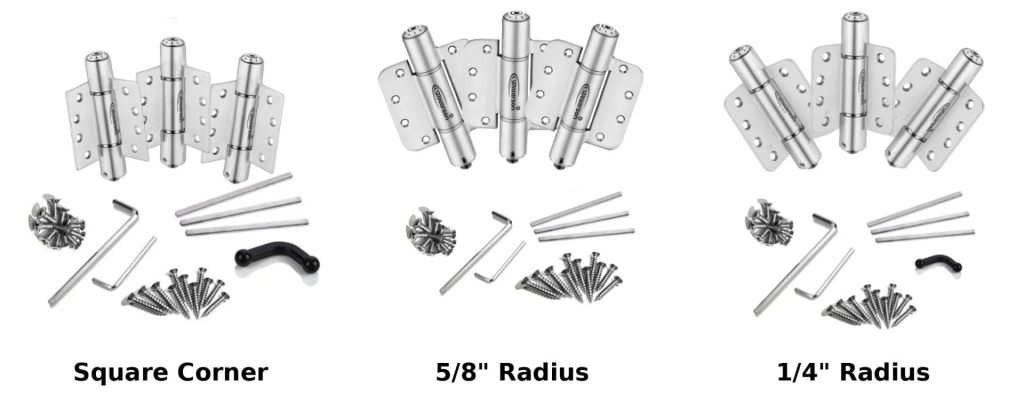
To measure replacement door hinges, record the hinge’s height, its width when open flat, and the shape of its corners. Those are separate details. Two hinges described as 3-1/2 inches can have different corner radii, so matching the large number on the package does not establish that a replacement fits the existing recess.
This guide helps US homeowners prepare a shopping record for ordinary residential butt hinges. It focuses on identifying the existing hardware before ordering. A heavy door, a special hinge mechanism, or a labeled door assembly needs product-specific advice. Measurements alone do not establish a suitable load rating or authorize a change to that assembly.
Make a record of the existing opening first
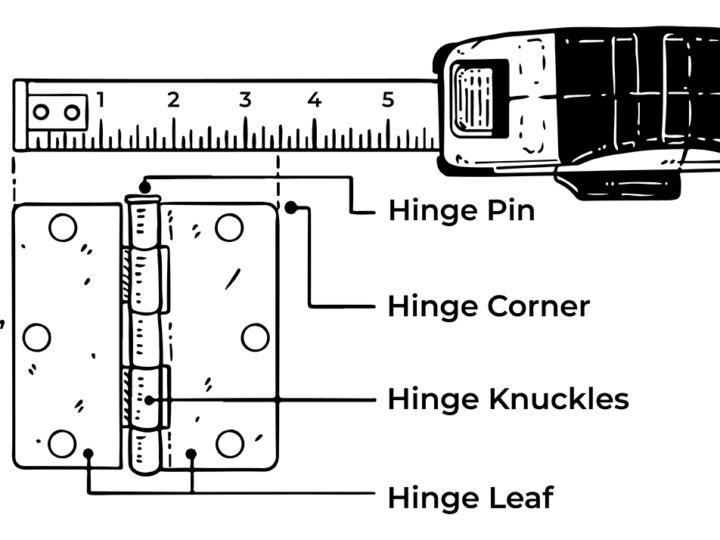
Photograph the whole door and each hinge with the door open and supported as needed. Take a close view that shows the outline of the metal leaf, its screw arrangement, and how it sits in the door and frame. A leaf is one of the two plates joined by the hinge’s pin and knuckles. The shallow recess receiving a leaf is called the mortise.
Write down how many hinges are installed and whether their shapes match. Record any readable brand or model information, the door’s thickness, and whether the opening is indoors or exposed to weather. Do not assume every door in the house uses the same hardware simply because the finish looks similar.
A purchase record is useful even when the reason for shopping is cosmetic. If the door also rubs, sags, or has loose screws, describe that separately. Buying a hinge with the right outline does not establish why the existing door operates poorly. Ask the installer or supplier to assess that symptom before treating a new finish as a repair.
Identify square corners and rounded corners separately
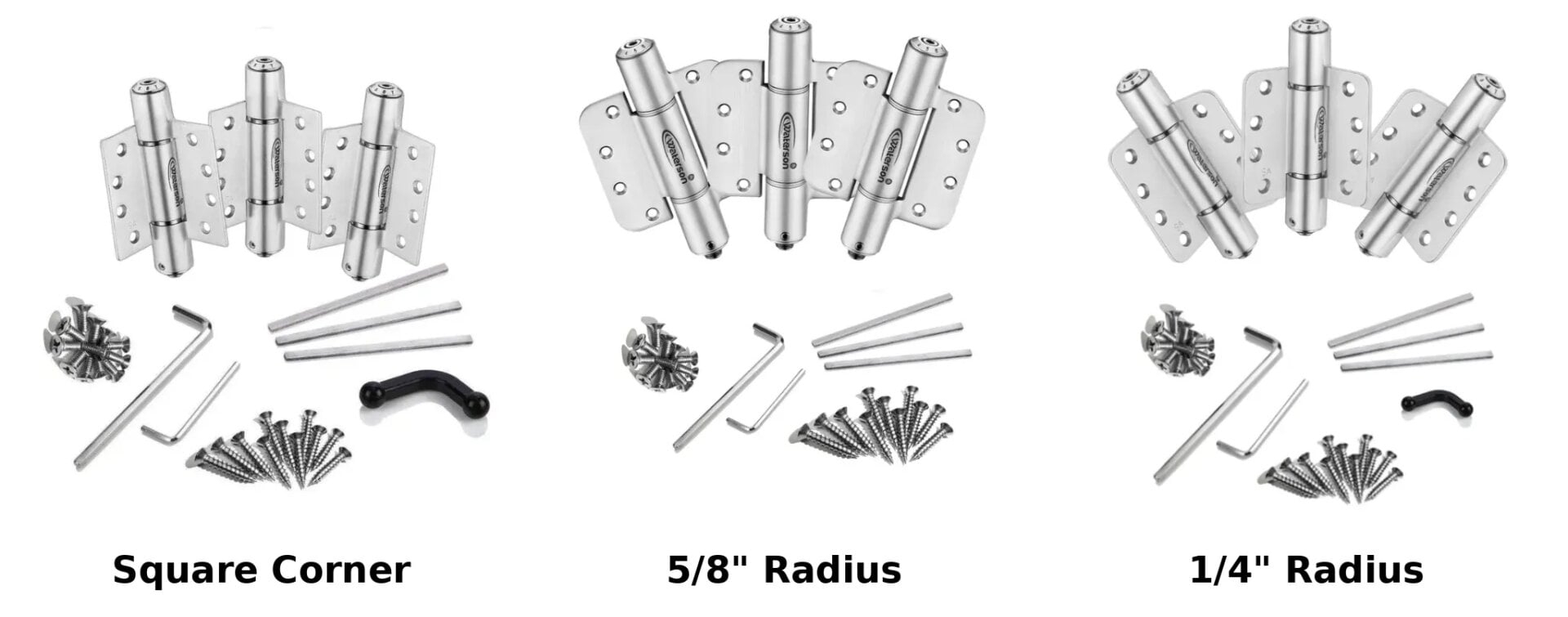
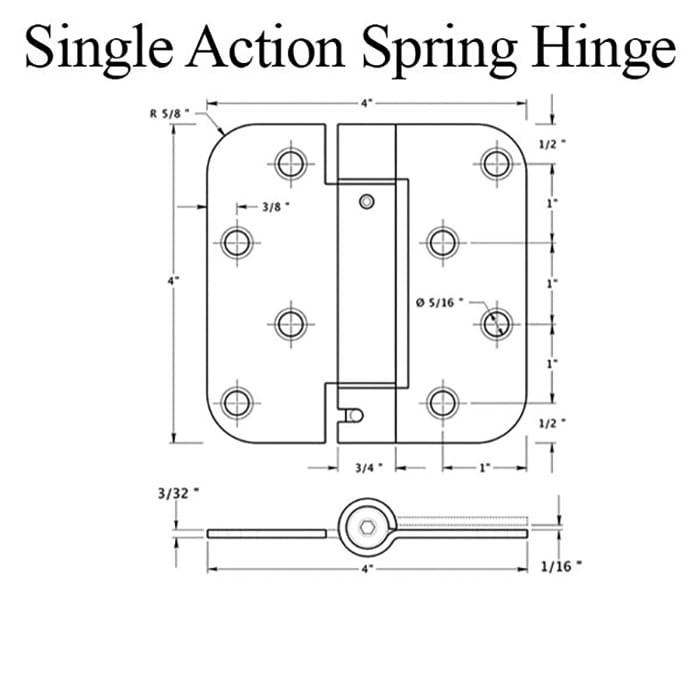
Schlage’s replacement hinge buying guide describes three corner styles in its range: square, 1/4-inch radius, and 5/8-inch radius. A square corner has a right angle; a radius corner is rounded. Look at the outer corners of the leaf, rather than the rounded barrel connecting the leaves.
For a quick comparison, Schlage says a dime fits the curve of a 1/4-inch radius corner and a quarter fits a 5/8-inch radius corner. Use that as an identification aid alongside a clear photograph and the product drawing. Paint buildup, an irregular old cutout, or an awkward viewing angle can make a visual comparison uncertain. Record uncertainty instead of forcing the nearest answer.
The radius label describes the corner curve, not the hinge’s overall height. Photograph the corner independently from the full hinge so the two details remain distinct in your notes. Schlage recommends choosing the same corner style as the existing hinge to make replacement easier. Do not order a different outline on the assumption that changing the recess will be a trivial part of installation.
Measure the hinge size using the seller’s dimension convention
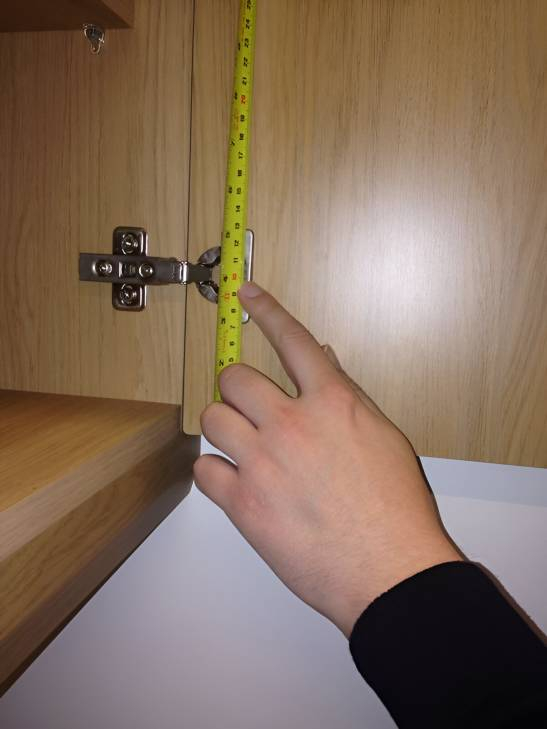
Schlage’s guide calls for measuring an existing hinge’s height and width and recording the door thickness. Its product pages clarify an important convention: the stated square dimensions are the dimensions of the hinge when open. A measurement across only one leaf is not the same record as the width across the complete open hinge.
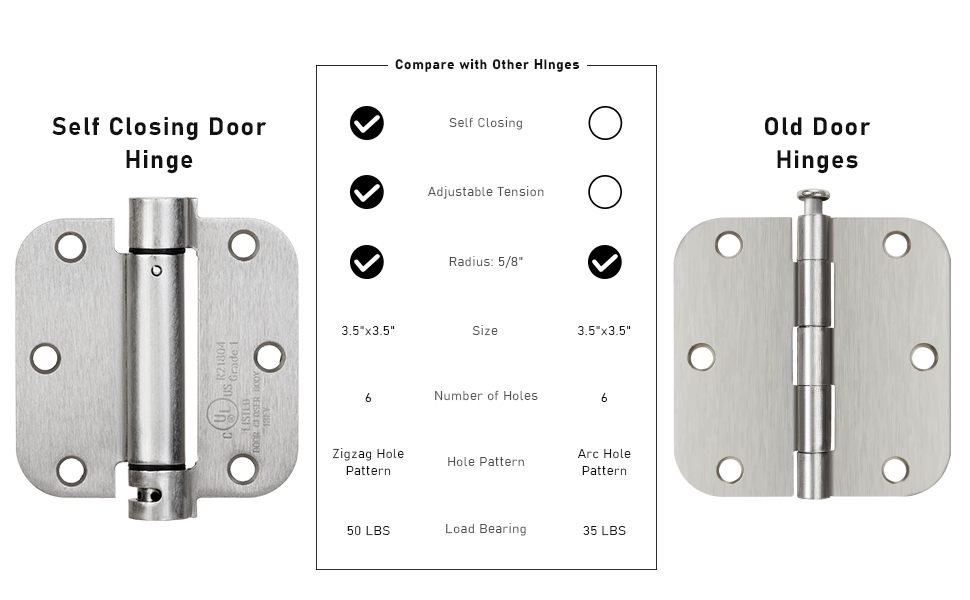
The manufacturer’s 3.5-inch hinge with a 1/4-inch radius, for example, lists open hinge dimensions of 3-1/2 by 3-1/2 inches. Its 3.5-inch hinge with a 5/8-inch radius lists the same open dimensions. These real examples show why the size and corner style must both appear on an order.
Where you cannot obtain a reliable measurement with the hinge in place, follow the door maker’s instructions or have an installer remove and measure a sample with the door properly supported. This shopping guide is not a removal sequence. Do not loosen several hinges just to lay them flat for a photograph.
Write the actual measurements in inches without rounding them to a preferred package size. Label the height and open width explicitly, and add the door thickness as a separate line. If a seller provides a dimensional drawing, compare the labeled drawing with your record rather than relying on the product photograph.
Compare the complete leaf and screw pattern
Check the proposed replacement against more than its finish and nominal size. Compare the leaf outline, screw locations, and available dimensional information. If the leaf thickness or another required dimension is absent from the listing, ask the supplier. An unanswered specification is an open question, not an implied match.
Schlage also suggests taking an existing hinge to the store or tracing its pattern on paper. If a sample has been removed appropriately, a full-size tracing can preserve details that a photograph hides. Label the tracing with the door location and measurements, and mark which part you traced. Include the screw holes so the supplier can compare the pattern.
For an online purchase, save a screenshot or PDF of the exact listing and its drawing. A listing with several selectable sizes or radii can change what is shown when another option is clicked. Confirm the option in the cart matches the dimensions you reviewed, then retain that record with the order confirmation.
Choose the finish after the fit is established
Compare the finish name on the replacement with the other hardware you intend to coordinate. A finish is a visual choice; it does not resolve a different radius, size, or hinge mechanism. Schlage lists finishes such as satin nickel, satin brass, matte black, bright chrome, and aged bronze, but availability depends on the particular product.
If you are also replacing a lever, keep that purchase record separate. Our guide to door handing for replacement levers explains why swing direction and the hardware maker’s ordering convention need their own checks. Identifying a hinge corner does not answer a lever’s handing question.
Send one clear specification before placing the order
Your final note should identify the door, the hinge height and open width, corner style, screw pattern, door thickness, hinge count, and desired finish. Attach the overall photograph, the corner close-up, and any verified model number. Ask the supplier to confirm the exact replacement and flag anything the measurements cannot establish.
When the parts arrive, compare their labels and outlines with that saved record before installation begins. Resolve a mismatched corner, size, or unexplained specification with the supplier first. A careful shopping record gives you a useful stopping point: you know what was measured, what was ordered, and which details still need confirmation.